Sunday, August 27, 2006

Old Naledi

Maps of Gaborone, Botswana, list the neighborhood’s name Old Naledi. Most residents of Botswana, however, know it as zola –Setswana word meaning “no rules.” According to legend, bureaucrats gave poor Batswana families plot numbers, then allowed them to set up their houses wherever they liked within the district, one by one. As a result, house number 100-46 is equally likely to be adjacent to 711-83 as to 100-47. No one has ever seriously considered naming – much less mapping – the labyrinth of dirt paths that run between the cinderblock and tin-roof houses. Police presence is minimal. Children and adults alike follow the one Big Rule: he who is bigger makes the rules.

But for all its faults, Old Naledi is not Haiti’s Cite Soliel or the slums of São Paolo, Brasil. First, the Batswana have an intense distaste for violence. Second, the Botswana government’s well-managed diamond wealth underwrites running water, sewerage, and basic health care, including ARVs for people living with HIV/AIDS.

As a result, the Old Naledi youth and children that Holy Cross Hospice serves are hungry, but not malnourished like other parts of Africa. The oung men struggle to find jobs, but do not group off into gangs. All the children are “handfuls,” but few are beyond control. They come from basic homes, but not constructed out of cardboard and scrap metal like in La Chureca in Nicaragua, where I spent last summer. And if their situation has filled them with anger, it has not depleted them of hope.

Thursday, August 24, 2006

Batswana Xylophones

In elementary school, I loathed music class. Hated it. I knew what music was supposed to sound like, and it certainly was not what came out of the various implements in Mrs. Whatzherface's classroom.

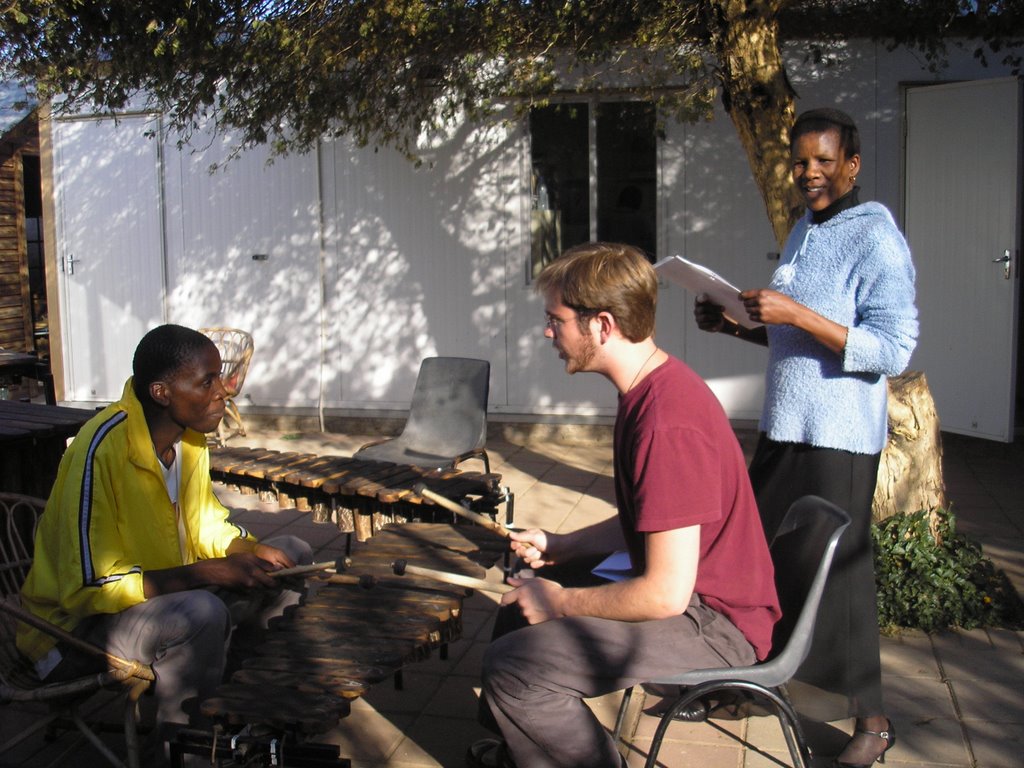
Imagine the intital grimace, then, as my colleague Newman informed me that I would be leading the marimba (huge xylophone) classes in our weekday youth program. He chose because of this scene,


when I jumped in with the actual marimba players during their practice.

Three lessons I have since learned:

    1) You can't put hammers in the hands of children or teenagers and expect them to control themselves. Into my classroom, I have built in "crazy time." When I say, "GO CRAZY!" the students get to hit whatever they want until I give them the conductor's cut off.

    2) Establishing order is task number one. The first thing I say, and the first thing each group practices, is to stop playing as soon as I give them the signal, placing the hammers behind their backs.

    3) Teaching is exhausting. Teachers should be paid like Presidents. And get daily foot massages.


Tuesday, August 22, 2006

Kgale Hill

I finally managed to upload a picture. Given how slow Blogger seems to be in Botswana, there may not be many more:


Meet Newman, a colleague of mine from Holy Cross Hospice. The view behind him is central Gaborone, from the top of Kgale Hill which we climbed Sunday afternoon.

Pictures

I tried to upload some pictures of Africa onto the blog, but am having little success. Until I can lick this blogger thing, those of you who are overwhelmingly curious (or bored) can check out the pictures of the previous Vanderbilt volunteers at Holy Cross Hospice, where I am working:

Ami: www.ofoto.com. Username ami.e.waters@gmail.com; password 527288.

Anne: www.snapfish.com. Username asasas@gmail.com; password asasas.

Thursday, August 17, 2006

Firsts

Four "firsts" this weekend:

1) An African sinus infection. Far more irritating than the American version.
2) Driving on real roads with a stick shift.
3) Driving on the left side of said roads, Commonwealth style.
4) Knicking the rearview mirror of an understandably irate doctor from the Ukraine.

Looking forward to weekend number two.

Saturday, August 12, 2006

Welcome to Gaborone

Forty-eight hours? Really? That's it?

For me, to introduce myself to another culture means a process more akin to jumping in the deep end than wading into the shallow. Which is why yesterday, when I walked by the softball fields for a second time in order to convince some local students to ask me if I might want to play, I was shocked myself to respond that I had in fact only been in Botswana for forty-eight hours, after having greeted the Batswana (Botswanan) boys with 'Dumela rra. Leina la gago ke mang?'

As a result, the initial 'So, what are your initial impressions of Botswana?' looms as the most difficult possible question; the culture-hopper receives more 'shoves' than impressions,' and they come, initially, at an overwhelming pace. For those ready to jump in alongside me into Gaborone, Botswana:

Begin with a commerical street you know: maybe Hillsboro Village in Nashville or Kings Highway (around Strawn's) in Shreveport. Now,

slow everything down,
just a little.

People are walking, not riding bikes. Even the fast cars do not seem to have quite the zip. The sun crawls, the wind slinks rather than whips through the trees.

Second, make everything just a little browner. Grass, faces, 'white' cars, streets, everything. Eskimos, I hear, have some hundred words for ice and snow; I should imagine that it should be the same for the color 'brown' here. Think drought-year, midsize midwestern town.

Now, look up. Clouds? Nope, blue skies. Every day, blue. Bring your gaze down a little, and if you are not surrounded by low-lying buildings, you will notice that you can see for miles. Everything in Gaborone is west-Texas flat, except for Kgale Hill some three miles (five kilometers) off.

Slower, browner, bluer, flatter: the beginner's introduction to the capital of Botswana. O amogetswe!

This is not really about Africa

I wrote this after a week in Long Beach, Mississippi last fall:

Like many other Vanderbilt students, I had been itching to do something-anything-to help the victims of August’s hurricanes. Sure, a couple canned goods and a check to the Red Cross was great, but I wanted to sink my hands into the mud that Katrina had left behind. And like most students, I had no idea how. I decided to go with the local Methodist/Episcopalian group on their Fall Break trip to Long Beach, Mississippi mainly because one of my friends invited me. I expected little out of the weekend. At best, I would be able to lend a yet-untrained hand; at worst, we would be in the way.

Camp Coast Care in Long Beach, Mississippi, however, floored me. An Episcopal and Lutheran outfit, the volunteer center covers a large swath of the Mississippi Gulf coastline. Started by a single priest in week two of the storm's aftermath, the camp has grown to a 150-bed headquarter for volunteers. A basketball gym borrowed from a high school, funds from the Episcopal Diocese, the organizational know-how of Lutheran Disaster Relief, and volunteers from Maine, Oregon and everywhere in between have come together to provide food, medical care, household goods, clothes, construction and demolition teams to residents of Harrison County, Mississippi. Volunteers get a place to sleep (or bring their own tents or campers), three meals a day, and a daily assignment.

And it is that simple, really. I spent two days clearing pine trees from lots and homes, and another greeting and registering storm victims as they entered the complex. At the end of three days, we packed up and left, making room for more volunteers from Indiana.

Just before the weekend, I had been reading Sickness Unto Death by Søren Kierkegaard for one of my religious studies classes. Kierkegaard is a Christian existentialist. Existentialists, roughly speaking, believe that life is ultimately meaningless, without purpose or direction, or that any meaning that we perceive is overlaid onto that otherwise meaningless existence. We exist, that's it. Sorry.

Some existentialists get a little more optimistic: we can, they might argue, create meaning ourselves. The Christian half of "Christian existentialism," from what I understand so far, implies that Kierkegaard brackets existentialism in the sense that yes, the world as it stands is meaningless and we live in a constant state of angst and despair; however, the Christian knows that this state is simply the absence of God in the world.

I haven't made up my mind on Kierkegaard or existentialism yet (or Christianity, for that matter). I tend to agree that life seems to be more of a cosmic crapshoot than anything else. Never have I heard any sort of theodicy (explanation of evil) that can keep gaze with, for example, the suffering of the street boys I met in Lima my freshman year. Things just don't make sense. "The rain falls," said one now-famous Jewish mystic, "on the just and the unjust alike."

But what I saw in Long Beach, Mississippi this weekend was a group of people creating meaning in a ten-block deep, forty-five mile wide wasteland of meaninglessness. There was hope in the eyes of people who had lost their everything and everyone, and there was love in the hands of those of us who reached out toward them. Somewhere, in that intersection of need and aid, meaning existed. I do not know if, like the existentialists, meaning was arbitrarily created. Maybe we found that which already exists apart from us, as a theologian might argue. But I watched despair turn into hope this weekend, and I am eager to watch that again.
Here Goes Nothing

FAQs about Africa

Where are you going?

Botswana - Gaborone, its capital, to be exact. If you look at a map of Africa, it is just north of South Africa, between Namibia and Mozambique.

What are you doing?

Not really sure. I will be working full-time for an HIV/AIDS hospice called Holy Cross. So far, I have heard about three potential responsibilities: one, playing with kids who have lost parents to AIDS; two, helping fundraise for a palliative (end of life) care clinic; and three, managing an income-generation project for HIV-positive women.

Who runs the hospice?
As far as I can tell, the Anglican church does, with some help from mostly European money.

When do you leave?

Sometime Saturday.

Where do you fly through?

Shreveport, Houston, Paris, Johannesburg, Gaborone; Gaborone, Johannesburg, Amsterdam, Memphis, Shreveport.

Holy cow, how long does that take?

About 36 hours. I don't want to talk about it.

Is it dangerous?

Nah. Botswana has a bunch of diamonds, so they have pretty good infrastructure, in addition to a stable democratic government - one of the few in Africa.

So you're not really roughing it, then?

Nope. In fact, I get to travel and play with kids all day, then talk with people back in the States and ask them to give their money away to a good cause. Not a bad deal.

When do you get back?

Early December.

What are you doing then?

(shoulder shrug).

The Body of Christ has AIDS

One of my current projects is to help Angela (a boss from Uganda who wears bright African prints, is an MD and MPH and raises three children here) put together an article on how the American Church, long absent in the response to AIDS, can involve itself in work with orphans and other vulnerable children.

The American Church, fortunately, has now woken up to the realization that the Body of Christ has AIDS. Two-thirds of HIV-infected people live in Sub-Saharan Africa, a region which is home to more Christians than North America. In addition, estimates suggest that fifteen million children worldwide have been orphaned by AIDS. Extended African family networks, which for centuries absorbed such children, have been overwhelmed by the AIDS pandemic.

Herein lie the opportunity, the calling, and the mandate of the Church: “Religion that is pure and undefiled before God, the Father, is this: to visit orphans and widows in their affliction...” exhorts Jesus' brother James. The Church must respond to this command to stand in the gap for the orphans and vulnerable children of Africa. In fact, they may be the only ones who can.

----------

Notes:
a) In HIV/AIDS literature, orphans and other vulnerable children (OVC) is a technical term that encompasses all children who have been infected or affected by AIDS.
b) In the development literature, an orphan has lost one parent. Children who lose both are called double orphans.
What is this FHI business?

Voice of America recently aired a show on AIDS, in light of last week's 25th anniversary of the discovery of HIV. Family Health International made considerable contributions to the segment, as it does in the response to HIV/AIDS. To see it, click here:

http://www.voanews.com/english/africa/healthyliving.cfm

and download the show on the right-hand side of the screen. Our president is quoted in the first part; our vice-president is interviewed more extensively in the latter part. (NB: Look out for her discussing orphans and other vulnerable children, which is the unit in which I work).
My new DC friend

"What are you doing?"

I turned from the post office, then looked down at my inquisitor. He was probaly four, had a bowl cut, and was wearing khaki shorts and sweater vest with nothing underneath. Kid had style.

"Um... I'm trying to get some stamps, and I don't know which ones to buy." I chose a book and started applying them to the last of my graduation thank you notes.

"What are those for?"

I looked around - no parent in sight. A women at a nearby counter smiled, but offered no help. This, clearly, was going to be my buddy for the rest of my post-office visit.

"Well, they're so that the postman knows that I paid to send my letters. Hmm... which slot do you think these go in?"

"I don't know. What does that say" He pointed to the words above the mail slots on the wall.

"F-L-A-T. Flat. This one says L-E-T-T-E-R-S. Letters. But I have a flat letter. What should I do?"

The little man put his hands on his hips, then pointed up at L-E-T-T-E-R-S, and said, "That one."

"Ok. I'll put the first two in. You put the last one." I stuck the last envelope halfway in the slot, then watched as he jumped up and high-fived the letter into L-E-T-T-E-R-S and put the rest of the stamps in my pocket.

"What are you going to do with those?"

"I'm going to save them and put them on some mo-"

"Jack - Jack!" I heard her before she came around the corner. "I'm sorry. Jack! Come over here."

Jack grinned and scrambled to his mother as I slipped away and out of the post-office. "See you later, Jack," I called over my shoulder.

Jack waved back with an awkward four-year-old/Forrest Gump wave. "See you later, Jack! Oh. Uh, see you later. Bye!"

DC is pretty sweet.
One week in

Before wandering to DC, I had a conversation with a friend of mine about how I would spend my time in DC. Picking the guitar back up? Shedding some of my soft college skin? Building "social capital?"** Catching up on the stack of books that have been building for the last four years? Being a museum junkie?

The days are just packed. And until they invent a pill that eliminates the need for sleep, I have to make some choices.

DC has intensified those choices; my internship with Family Health International has made them a bit easier by sheer dent of the brain-space it requires. In the last week-and-a-half, I have had real-time, sink-or-swim courses on corporate restructuring and office politics, clinical pediatric AIDS care, the public sector penchant for acronyms, non-profit funding crunches, the shameful politicization of crucial public health issues, and best-practices for orphans and other vulnerable children (OVC). I work hard from 8:30 to 5:00 every day, learning on the fly. Give it another week, and it will be 5:30... then likely 6:00...

That is how I like it, going to bed every night knowing that I have a full day ahead of me - and that the following night will be the same.

More later; I need to get back to life.


**"Building social capital" basically just means going out for drinks. People in DC make up buzzwords for everything.
Gettin' busy

Just finished Day One of my internship at Family Health International. Turns out I will be workring primarily with the Orphans and Vulnerable Children (OVC) Unit, an assignment that fits pretty well given my history in Peru and my future work in Botswana.

One of my potential assignments is to co-author an article for Christianity Today about the role that the American Church could play in the AIDS crisis, a curious and exciting assignment. I spent part of the afternoon researching the contribution that local African congregations are making to sustain their own communities in the wake of the death of hundreds of parents ; it is encouraging to imagine the impact the effect which the focused resources of American churches could have on the micro-scale efforts of these community efforts.
On again off again

Welcome back! If you are new to reading "Where is Mark?," this is a website where I post pictures and stories from my round-the-world travels. I am flattered that you are here, and would love to hear from you.

Over the next few months, I will be traveling to Washington, DC for an internship at Family Health International (click here for their website). After that, I will spend four months based in Gaborone, the capital of Botswana, working at the Holy Cross Hospice. You can read a little more about that at the bottom of the St. Augustine's webpage (click here). After that I will be back in the country for a while (maybe) until I hopefully move to Ecuador to begin working on a new Manna Project International site (click here for MPI's homepage).

Here we go!